
How is sustainability actually perceived by students at CAMPUS 02 UAS?
As part of the Sustainability and Ethics course, students explored this question systematically. In a Sustainability Rally, they analysed infrastructure, processes and everyday practices at CAMPUS 02 UAS, with the aim of making sustainability performance visible and identifying concrete areas for improvement. This article is based on a summary by the course lecturer, Rafal Fabianowicz, BA, MA, MSc, FHEA.
Teaching Content, Method and Learning Objectives
The course is part of the Department of Marketing & Sales curriculum and combined several learning objectives: understanding sustainability, developing reporting skills and fostering applied thinking. The chosen method was Design Thinking—observing with empathy, defining problems, outlining solutions, prototyping and reflecting. Educational research shows that Design Thinking enables students to develop sustainability competencies in a practical way and to create interdisciplinary solutions.
Where Sustainability Is Already Visible – A Solid Starting Point
The students’ analysis paints a nuanced picture of sustainability performance at CAMPUS 02 UAS. In several areas, key measures are already clearly visible.
The building design was particularly frequently highlighted in a positive light. Large windows and glass surfaces allow for extensive use of daylight, reducing the need for artificial lighting during the day. Students also observed that lighting is partially reduced in the evenings—an indication of an existing awareness of energy conservation.
The groups considered the photovoltaic systems at the university to be of long-term strategic importance. These were seen as a clear commitment to renewable energy, both from an ecological and an economic perspective (CO₂ reduction and cost savings). In addition, LED lighting and motion sensors already installed in certain areas were identified as positive efficiency measures.
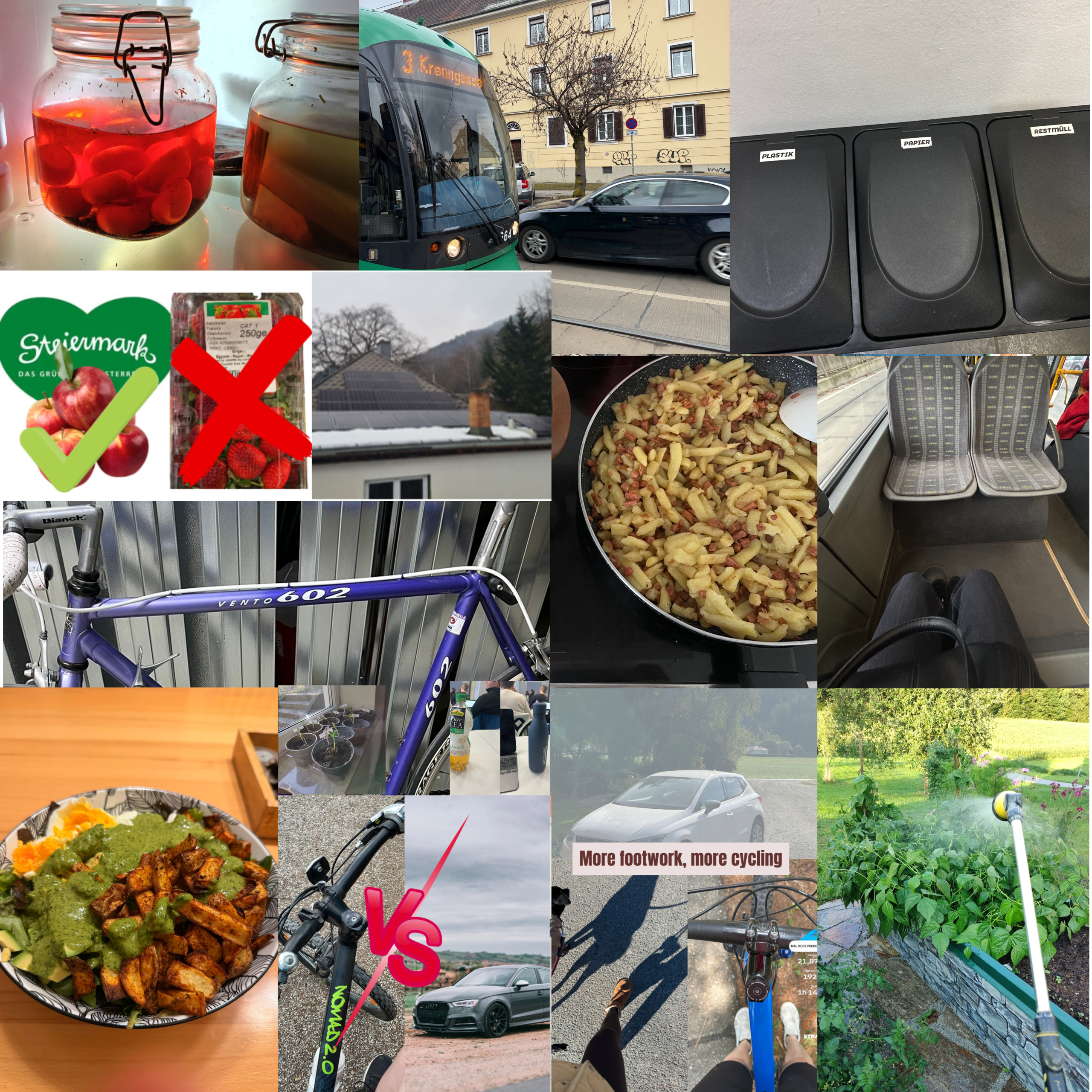
In terms of sustainable mobility, several groups emphasised the good public transport connections, including nearby bus stops, as well as the numerous bicycle parking facilities. This makes climate-friendly travel significantly easier. The location on the outskirts of the city was also perceived as an advantage: less traffic, a greener environment and a calmer learning atmosphere. Sustainability here was interpreted not only in technical terms but also in terms of atmosphere.
Further positive aspects included:
- Separate waste collection systems for paper, plastic, glass and residual waste—the principle of waste separation is established and well known among students.
- Digital teaching materials and online submissions, which significantly reduce paper consumption.
- The reuse of an existing building by Breda University of Applied Sciences instead of constructing a new one—seen as a resource-efficient decision.
- Shared use of spaces with other institutions, promoting efficient use of space and resource sharing.
Overall, the conclusion was clear: CAMPUS 02 UAS is “not starting from scratch” but already has a solid sustainable foundation.
Where Students See Potential for Improvement
The operational areas for action identified by students primarily focus on optimising ongoing operations across various parts of the campus. A central aspect is lighting control in corridors and communal areas, where increased use of sensors and adjustments to daylight levels could improve energy efficiency. At the same time, potential improvements were identified in insulation and heating systems within the technical infrastructure.
In the area of catering, the focus is on reducing single-use packaging, with reusable alternatives and incentive schemes such as “Refill & Save” suggested as solutions.
With regard to interior design, the integration of plants was proposed as a measure to improve air quality and well-being. This reflects a broader understanding of sustainability, linking ecological factors with the visual enhancement of the learning environment.
Classification and Perspective
In conclusion, the course provides a clear picture: sustainability at CAMPUS 02 UAS is consciously perceived—critically, constructively and with a well-developed understanding of interconnections. Students recognise existing strengths while also clearly identifying areas where targeted adjustments could create additional impact.
It becomes particularly evident that, for students, sustainability is not solely about major investments. Rather, it is about consistent operational optimisation, transparent communication and the visible integration of sustainable principles into everyday life. Small, well-considered measures can lead to tangible change—both ecologically and in how sustainability is perceived within the university community.
For CAMPUS 02 UAS, this offers a valuable perspective: when sustainability is not only implemented but also continuously reflected upon, further developed and shaped collaboratively, it creates a campus that credibly combines learning and responsibility. The Sustainability Rally has demonstrated that this potential clearly exists.