In time for International Women’s Day, we are shining a spotlight on an initiative that is redefining networking and growth opportunities for women at our university of applied sciences. The FIONA project has quickly developed into an important point of contact.
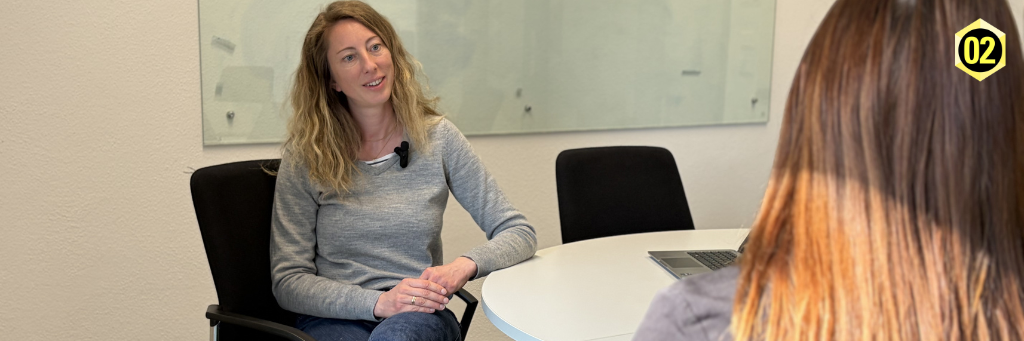
In today’s interview with Stefanie Hatzl, we discuss how it all began, the vision driving the team, and why mutual exchange is so valuable. She has been involved in the project from the very beginning and shares what makes FIONA so special.
Stefanie, it’s great to have you here. Could you briefly tell us who you are and what your role is at FH CAMPUS 02?
S: I am an R&D coordinator in the Department of IT & Business Informatics, and I am primarily responsible for projects—whether they are academic research projects, implementation projects, or corporate collaborations.
What exactly does the name “FIONA” stand for?
S: Women’s Initiative for Organisation, Networking and Education at CAMPUS 02 UAS.
How did the idea for this project come about, and when did it officially start?
S: The idea came from our managing director following a funding call from LEA, an initiative of the Austrian Fund for the Strengthening and Promotion of Women and Girls. She wanted to seize the opportunity to particularly support and empower female students in technical degree programmes. The project officially started on 1 April 2024.
What did the first steps look like?
S: The first step was to bring motivated women from the three technical departments on board so that we could jointly develop a programme. After receiving the funding, we met regularly as a team to design and implement a detailed FIONA programme together.
What are your concrete goals with FIONA? What is the vision behind it?
S: Initially, the focus was on encouraging girls and school pupils to take an interest in technology and on strengthening female students in technical degree programmes—particularly during the initial phase of their studies. This includes TechDays as a taster week for pupils, a self-paced mathematics course, and networking and empowerment opportunities, among others through the FIONA Connect women’s network and the mentoring programme. The overarching vision is to inspire girls and women to pursue technical studies and careers and to support them in achieving their educational goals.
Who can take part? Are there specific requirements, or who would you particularly recommend participating?
S: At the beginning, participation in the student programmes was limited to female students and graduates of technical degree programmes. In the second year, we opened up certain elements—for example, the self-paced mathematics course is now available to all students, regardless of gender or department; in the mentoring programme, male students can now also act as mentors for first-semester female students; and the FIONA Connect networking events were opened—after just the second meeting—to all female students, regardless of department.
How many participants are involved so far?
S: It varies depending on the programme. For example, over 370 students have already taken part in the self-paced mathematics course; around 40 female students have attended the FIONA Connect networking events; and we have informed approximately 1,000 people about FIONA overall, as we present the programme at school visits, fairs, and information events.
What does a typical FIONA Connect meeting look like? How often do these meetings take place, and when are the next ones scheduled?
S: The meetings vary in format. So far, we have held five meetings—typically two per semester. Activities have included inviting female graduates from the technical departments to share insights into their career paths after university, a city walk with Graz Guides, a female leadership workshop, and an exchange with FAME (a University of Graz programme supporting female students across all disciplines, including those from universities of applied sciences, as well as academics on educational or parental leave and alumni).
Where and how can people register for the FIONA Connect networking events?
S: Dates are published on the website along with a registration link, and invitation emails are also sent out.
What are the next planned milestones? Where do you see FIONA in a year’s time?
We have submitted a follow-up project to expand the FIONA programme. Our aims include: developing multimedia, target-group-specific career orientation materials based on real career biographies of female students and graduates in technical fields; 2a) further improving the didactic design of the self-paced mathematics course and integrating it across the university; 2b) offering guided group coaching for female students on self-efficacy, career orientation, and decision-making; 2c) further developing the mentoring programme by creating a pool of female experts in technical professions; and structurally embedding FIONA Connect within the university. Staff, alumni, and external experts will be involved and connected with regional women’s networks to enhance visibility and cross-organisational impact.
Finally, do you have a message or piece of advice for all the women reading today?
Many women think, “A separate network for women? I don’t need that!” But honestly—together, we often get further. Women’s networks are not an extra; they are a source of momentum. So let’s support one another, share experiences, and encourage each other to follow our own paths.