
Lecturers’ Visions for Higher Education: A Participatory Futures Perspective
Higher Education (HE) is undergoing profound transformation driven by shifting student expectations, changing learning cultures, and the pervasive influence of artificial intelligence (AI). To explore how institutions can respond proactively, a futures-oriented workshop was conducted with university lecturers using a creative, collaborative format. Participants engaged with guiding questions on the future role of educators, expectations of upcoming student generations, essential graduate competencies, future learning spaces, and assessment design in an AI-rich environment.
Across all areas, participants highlighted the growing importance of human-centred, flexible, and ethically grounded approaches to teaching and learning. Regarding the role of educators, the findings indicate a shift towards coaching, mentoring, and moderating learning processes. Empathy, constructive feedback, enthusiasm, and boundary-setting were seen as increasingly decisive, although AI literacy remains necessary. In terms of future student expectations, individualisation, flexibility, modularisation, and transparent communication of purpose were identified as core demands and needs of Generation Z (and Alpha). Educators will need to guide students through increasingly virtual and digitally mediated learning journeys. According to the lecturers, graduates in 2035 must combine analytical, systemic, and problem-solving abilities with social and ethical competencies, including responsibility, inclusivity, resilience, and environmental awareness. Participants emphasised that cultivating such competencies requires learning environments that are both academically challenging and personally developmental. Future learning spaces should therefore incorporate flexible, modular physical settings combined with immersive and hybrid digital infrastructures. Such spaces should enable collaboration, creativity, and quiet reflection, supported by adaptable layouts, high technical standards, and AI-driven personalisation. These environments must also align with future assessment practices, where participants called for competence-oriented, fair, and process-focused approaches. Portfolios, project work, open-book formats, oral examinations, and continuous formative assessment were identified as strategies that maintain academic integrity while integrating AI as a supportive tool rather than a shortcut. At the same time, the shift from product to process was emphasised, along with the continued relevance of written paper-and-pencil exams.
Overall, the findings point to the need for a holistic transformation across pedagogy, learning spaces, graduate competencies, and institutional strategy. Preparing for the future of HE will require an integrated approach that places emphasis on human-centred teaching, flexible and adaptive learning ecosystems, ethically grounded and practice-oriented competencies, and assessment formats suited to an AI-enhanced environment.
In addition to presenting the workshop findings, this contribution offers hands-on, research-informed examples and good practices that illustrate and critically discuss how the areas explored can be translated into concrete action.
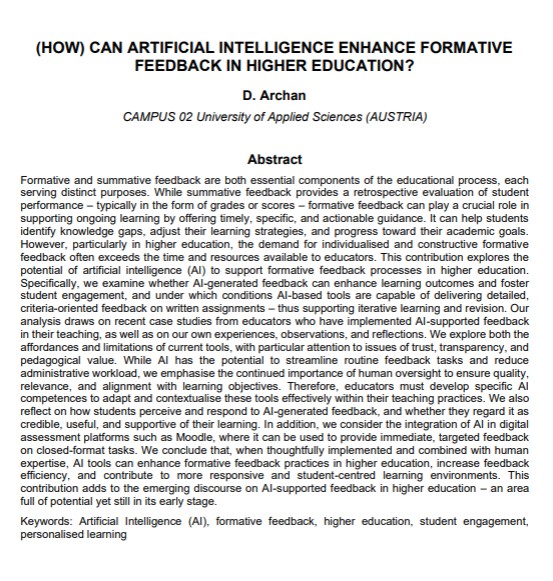
Formative feedback is widely recognised as a powerful driver of learning in higher education, enabling students to identify gaps in their understanding and improve their work iteratively. Unlike summative feedback, which summarises performance after completion, formative feedback supports ongoing development with timely, targeted advice. Yet in practice, the demand for individualised feedback often exceeds the time and resources available to lecturers, leaving students with limited opportunities to engage meaningfully with their learning process. Recent initiatives have begun exploring whether artificial intelligence (AI) can help address this gap. AI can automate or semi-automate parts of the feedback cycle – for example, analysing text drafts against given criteria, pointing out strengths and weaknesses, and suggesting improvements. Tools like Fobizz or FelloFish allow lecturers to provide prompts and criteria in advance, ensuring that feedback aligns with course objectives. This shifts the lecturer’s role from sole feedback provider to facilitator, guiding students in critically reflecting on AI-generated suggestions and integrating them into their revisions.
In order to find out more about the role of AI in formative feedback, I conducted research and wrote the eCampus Use Case “Lernförderliches Feedback mit KI – KI-Tools für formatives Feedback einsetzen”. In addition, I programmed a feedback tool (FelloFish) to give feedback to students’ writing in one of my English classes at a university of applied sciences. I have analysed the AI tool’s feedback and asked my students how they felt dealing with AI feedback. The sample is small and my research still in its infancy. Nevertheless, I think I can provide a valuable snapshot on this interesting topic.
Initial findings are promising. Students participating in the AI feedback pilot described the input as “very helpful” or “somewhat helpful” in a majority of responses. They particularly valued the neutral tone of the feedback and the way it offered concrete suggestions rather than personal judgment. Several students highlighted the usefulness of specific features, such as tips on sentence building, recommended vocabulary, and examples showing how to improve weak sections of their texts. One student explicitly noted that the feedback “criticised and also gave examples,” which made it easier to act on. Another appreciated that AI feedback felt impartial: it did not carry the emotional weight that sometimes comes with teacher evaluations. Not all responses were unreservedly positive. A few students reported confusion, particularly about certain visual indicators such as score meters, which were not always clearly explained. Some were unsure how to interpret AI feedback in relation to teacher expectations, raising the need for clearer guidance on how both feedback sources interact. While most students expressed interest in receiving AI feedback in future writing tasks – often framing it as a useful supplement – they also acknowledged the continuing value of human input. Several described an “ideal balance” as 50:50, or suggested that AI should provide the first layer of feedback while the teacher offers deeper commentary on content and critical thinking. This nuanced response aligns with broader findings, which caution against outsourcing feedback entirely to AI and instead advocate a complementary approach.
The benefits of AI-supported formative feedback extend beyond immediacy and scalability. Automated feedback allows for more iterative drafting cycles, enabling students to revise multiple times without waiting days or weeks for comments. In courses with large enrollments, this can substantially increase opportunities for meaningful engagement with feedback. Moreover, the perceived neutrality of AI responses may reduce anxiety in some students, encouraging them to take risks and experiment with revisions. However, these benefits depend heavily on the quality of prompts and criteria provided by educators; vague or overly general input can result in inconsistent or unhelpful feedback, as documented in the case studies.
Pedagogically, integrating AI into feedback processes requires thoughtful planning. Lecturers must decide at which stages of learning AI is most useful – for example, in early drafting versus final polishing – and prepare students to engage critically with machine-generated advice. The importance of reflection can never be underestimated: teachers should review AI feedback with students, discussing its strengths, limitations, and alignment with learning goals. This practice not only ensures quality control but also fosters media literacy, equipping students to navigate AI tools independently in future academic or professional contexts.
Policy implications are equally important. Universities should provide structured support for lecturers who wish to adopt AI in feedback processes, including training on prompt engineering, ethical considerations, and data privacy. Centralised, privacy-compliant platforms can reduce risks associated with commercial AI tools while ensuring consistent standards across courses. Clear institutional guidelines are needed to define appropriate uses of AI feedback, clarify its relationship to assessment policies, and communicate transparently with students about how their data is handled. At the national or cross-institutional level, developing shared frameworks for AI literacy could help avoid fragmented approaches and ensure equity between institutions.
The student survey findings underscore the importance of involving learners in these discussions. Their reactions show both enthusiasm and caution: while many welcome AI as a time-saving and motivating tool, they also recognise that it lacks the depth and personalisation of human feedback. Policy makers should therefore view AI not as a replacement for educators but as a means to enhance existing pedagogical practices. Investing in faculty development and clear communication strategies will be essential to building trust and ensuring that AI feedback serves learning rather than undermines it.
Although these pilot results suggest strong potential, the initiative is still under evaluation. Further research will need to examine long-term effects on learning outcomes, writing quality, and student motivation, as well as the impact on faculty workload and perceptions of teaching quality. Questions remain about how to balance AI and human input, tailor tools to different disciplines, and manage ethical concerns in rapidly evolving technological landscapes. Nevertheless, one principle is clear: when thoughtfully implemented, AI can amplify rather than diminish human expertise, enabling more responsive and student-centered feedback practices in higher education.
Artificial Intelligence (AI) is transforming higher education (HE), bringing both opportunities and challenges. As lecturers play a key role in the effective integration of AI in university teaching, this study focuses on two essential factors: AI literacy and trust in AI. To explore these dimensions, a survey was conducted among university lecturers in Austria and Serbia. The study assessed educators‘ self-reported AI literacy and examined their levels of trust in AI across various educational contexts. The findings offer a nuanced understanding of how lecturers perceive and engage with AI, highlighting potential gaps and strengths in their preparedness. This analysis provides valuable insights that can serve as a basis for the development of future university policies aimed at supporting the thoughtful and effective use of AI in higher education. By addressing both competence and confidence in AI, the study contributes to a more informed and strategic approach to digital transformation in academic settings.

Künstliche Intelligenz (KI) ist im Hochschulsektor angekommen und entwickelt sich mit rasender Geschwindigkeit weiter. Die damit einhergehenden Veränderungen stellen Lehrende vor die Herausforderung, KI-Kompetenzen zu entwickeln und bereits bestehende Kompetenzen zu verbessern, um KI-Technologien didaktisch sinnvoll in ihren Unterricht integrieren zu können. Denn da Wirtschaft und Gesellschaft erwarten, dass Absolvent*innen mit den notwendigen Fähigkeiten ausgestattet werden, um in einer zunehmend KI-gestützten Arbeitswelt erfolgreich zu sein, müssen diese Skills in den Curricula verankert werden. Doch was bedeutet der Begriff „KI-Kompetenzen“ (oder AI literacy) nun, und welche Fähigkeiten benötigen Lehrende tatsächlich, um Lehre am Puls der Zeit umzusetzen?
Workshop am 11. Tag der Lehre der FH Oberösterreich
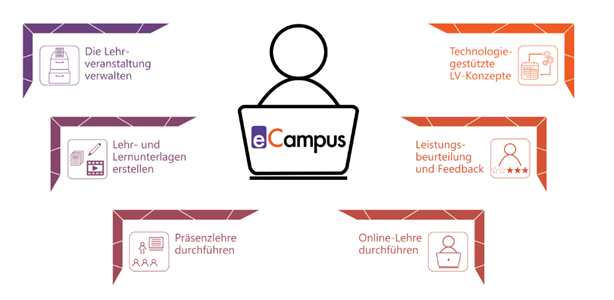
Expert*innen diagnostizieren dem gängigen System der Hochschulbildung, dass es nur unzureichend Antworten auf die komplexen Fragestellungen und Herausforderungen der heutigen Zeit liefern kann und keine wirklich nachhaltigen sozialen oder wirtschaftlichen Konzepte zur Bewältigung der Zukunft parat hat. Es liegt an den Curriculumsverantwortlichen, Studienpläne zu adaptieren bzw. zu erstellen, die die Vermittlung der sogenannten Future Skills berücksichtigen. Wie können Lehrende nun ihre eigenen diesbezüglichen Kompetenzen schulen und diese an Studierende weitergeben? Mit dem eCampus, einem Projekt, das von der FH CAMPUS 02, der Universität Graz und der Technischen Universität Graz entwickelt wurde, steht ein eService zur Verfügung, das es ab Mitte 2023 allen Lehrpersonen an österreichischen Hochschulen ermöglicht, technologiegestützte Ansätze für die eigene Lehre zu finden.
Online-Präsentation im Rahmen der INTED 2023 Conference in Valencia (Spanien).
PowerPoint Präsentation inkl. Ergebnissen aus der dazugehörigen Sli.do Umfrage im Rahmen des 21. E-Learning Tag der FH Joanneum
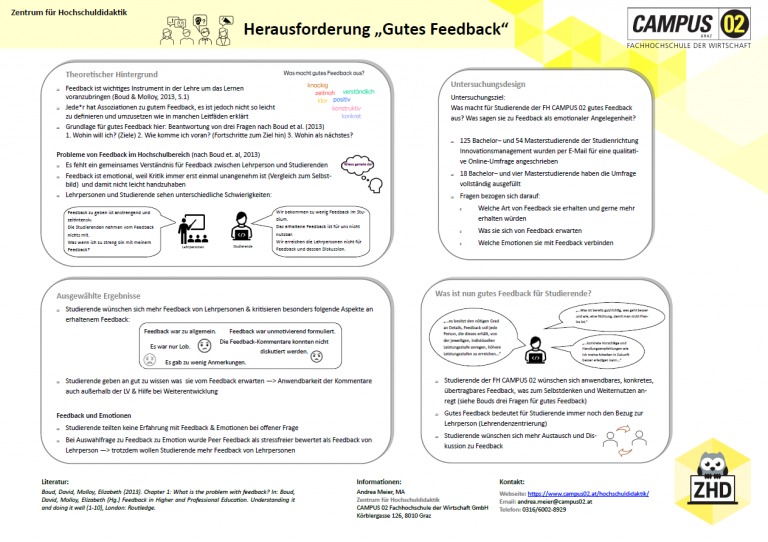
Poster im Rahmen des 21. E-Learning Tag der FH Joanneum